
Marriage counseling in Castle Rock, CO helps couples break destructive conflict cycles (criticism, contempt, defensiveness, stonewalling) and rebuild emotional safety. Research shows about 70% of couples improve with therapy. At Lifetouch Counseling, we use Emotionally Focused Therapy and infidelity recovery, in person or via telehealth.
Most couples who come to my office in Castle Rock tell me the same thing in the first ten minutes: “We keep having the same fight.” Sometimes it’s chores or money. Sometimes it’s an old hurt that never quite healed.
Underneath that, there’s usually a quieter confession: “We feel more like roommates than partners.”
If that’s where you are, you aren’t failing. You’re stuck in a pattern, and patterns can change.
I’ve been married for more than 25 years, and there were seasons when it didn’t come easily. Ten years of sitting with couples here in Douglas County has shown me how quickly a marriage slides into the “roommate phase,” and how often, with the right help, couples climb back out.
Key Takeaways
- The same fight is a pattern, not a flaw. It’s a nervous system loop, and you can learn to interrupt it together.
- Communication tools fail because of flooding. I call this moment the Somatic Gap. A 20-minute pause helps you cross it.
- Couples therapy helps most couples. About 70% improve, and Emotionally Focused Therapy holds up well over time.
- Trust can come back after an affair. Honest disclosure and a clear, three-phase process make the difference.
- Starting is low-risk. Sessions are $175 for 50 minutes, in person or online, and the first consultation is free.
Recognizing Destructive Communication Cycles: Why Do We Keep Having the Same Fight?
Couples keep having the same fight because the topic was never the real problem. The real problem is a cycle: one partner reaches for connection, the other pulls back to feel safe, and both end up lonely. Marriage counseling makes that cycle visible, so the two of you can work against the pattern instead of each other.
Most people assume counseling will teach them what to say. In my office, that’s rarely the missing piece. Couples usually know the words; what they lack is enough safety to say them out loud.
What Are the Four Horsemen, and What Do They Sound Like at Home?
Dr. John Gottman spent decades watching couples argue, starting with Gottman and Levenson’s long-term study of married couples. Four patterns kept showing up in marriages that later fell apart, and the Gottman Institute names contempt as the single greatest predictor of divorce.
You’ll probably recognize at least one. I hear all four most weeks:
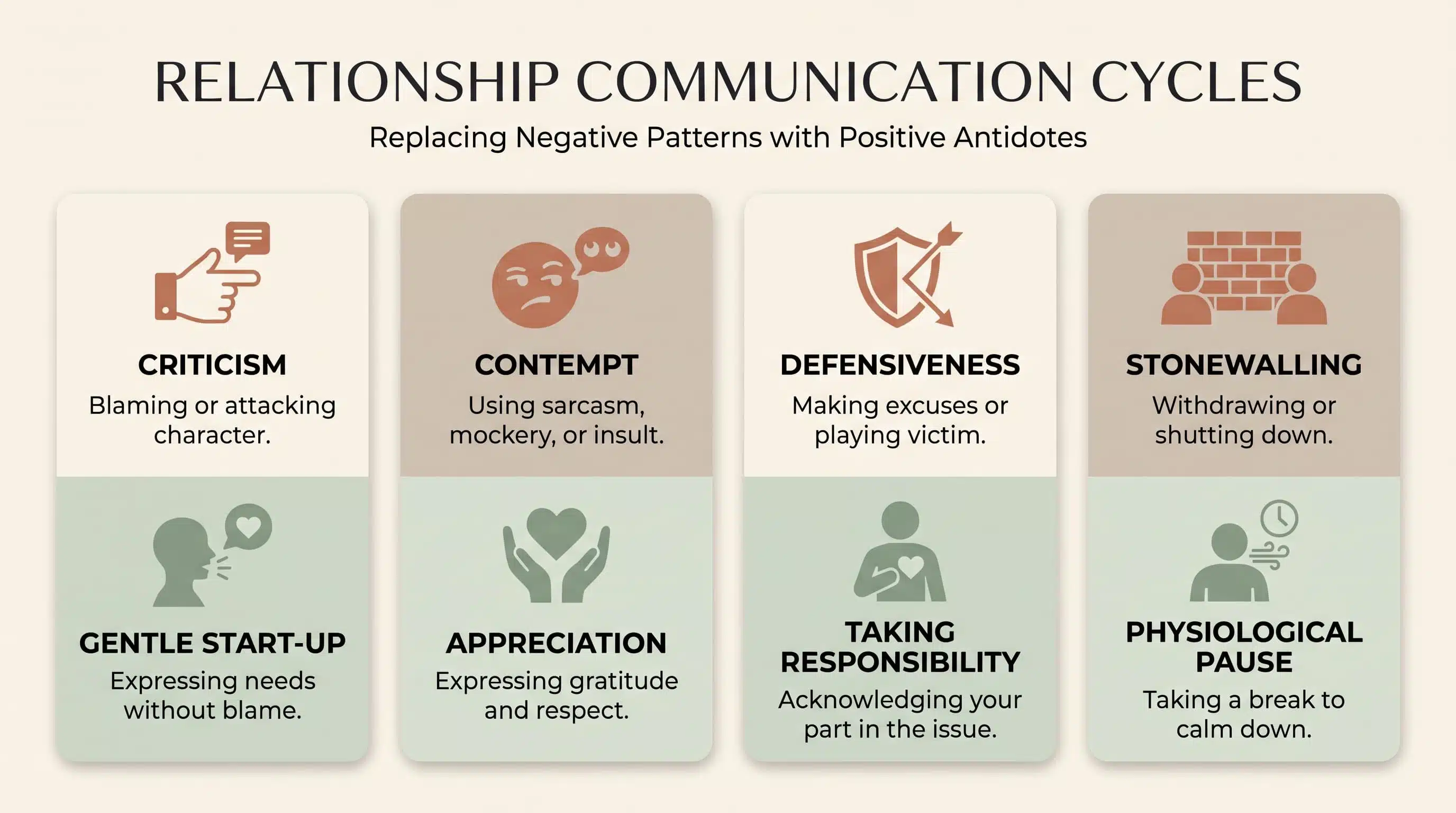
| Pattern | What it sounds like at home | What we practice instead |
| Criticism | “You never think about anyone but yourself.” | A gentle start-up: “I felt alone tonight. Can we talk?” |
| Contempt | Eye-rolling, sarcasm, “Must be nice.” | Building a habit of appreciation and respect |
| Defensiveness | “Well, you forgot last week.” | Taking responsibility for even a small part |
| Stonewalling | Going silent, scrolling, leaving the room | Pausing to calm your body, then coming back |
Stonewalling gets misread more than any of the others. The partner who goes silent usually cares a great deal; their nervous system has simply hit overload and shut the door.
Why Do Communication Skills Fail Mid-Fight? (The Somatic Gap)
You’ve probably tried “I-statements.” And you’ve probably noticed they vanish the second you’re actually upset.
Blame biology, not effort. I call that moment the Somatic Gap: your nervous system grabs the wheel, and the part of your brain that listens goes quiet.
- Flooding hits the body first. According to the Gottman Institute’s research on physiological flooding, heart rate climbs above roughly 100 beats per minute and stress hormones surge.
- Listening shuts down. Once you’re flooded, your partner’s words barely register, however hard you try.
- A real pause helps. Take at least 20 minutes and do something that settles you (a walk, slow breathing, a shower) before you try again.
- Counseling trains an early warning. Over time, you learn to notice the spike before it turns into a blowup.
Conflict takes a physical toll as well. When researchers at Ohio State University studied married couples, hostile arguments were linked to slower wound healing.
If you’re nodding along, you don’t need the right words ready before you call. Talk through your cycle in a free 15-minute call, and think of it as a conversation rather than a commitment.
Is It the Argument, or the Cycle?
Most stuck couples land in a pursue-withdraw cycle. One partner pushes for closeness, the other retreats, and every move makes the other person’s fear a little worse. Nobody here is the villain.
Learning to calm each other’s nervous systems (what I call co-regulation in couples counseling) is how couples step out of that loop.
If this section described your kitchen table a little too well, read what to expect in your first therapy session in Castle Rock. Most people find it gentler than they feared.
Knowing the pattern is one thing. Changing it takes practice, and usually some help.
Evidence-Based Approaches to Couples Therapy: Does Marriage Counseling Actually Work?
For most couples, yes. A major review of couples therapy research found that about 70% of couples in therapy show positive change, a rate comparable to individual therapy (Lebow et al., 2012). Approaches like Emotionally Focused Therapy help because they change how partners respond to each other’s emotions, not only what they say.
The couples I see improve most don’t necessarily fight less. They get faster at repair, at finding their way back to each other after a rough night.
How Do EFT, IBCT, and Gottman Research Differ?
| Approach | Main focus | How we use it at Lifetouch |
| Emotionally Focused Therapy (EFT) | Healing the emotional bond by finding the hurt or fear beneath anger and withdrawal | Our core couples model |
| Integrative Behavioral Couple Therapy (IBCT) | Accepting real differences while building practical skills | Woven in for communication and problem-solving |
| Gottman research | Observable patterns that predict relationship health | A research lens for spotting the Four Horsemen |
Put simply: we help you understand the feelings behind the fights, accept the differences that aren’t going anywhere, and swap harmful habits for better ones.
The evidence for EFT is solid. A 2024 meta-analysis of 20 EFT studies found that about 70% of couples were no longer distressed by the end of treatment, and those gains held for up to two years (Spengler et al., 2024).
What Happens in Marriage Counseling, Step by Step?
No two couples follow exactly the same path, but the work tends to unfold like this:
- Free 15-minute consultation. You ask your questions and get a sense of whether we’re a good fit. Nothing is decided on this call.
- Getting to know your story. We look at your history, your strengths, and what finally brought you in. I also check for safety.
- Mapping your cycle. Together, we name the pattern that keeps repeating, so it becomes the thing you’re both fighting.
- Calming things down. You learn to spot flooding, take a real pause, and come back without escalating.
- Repair and reconnection. You practice reaching for each other with the needs underneath the argument: “Do I matter to you? Are you there for me?”
- Strengthening what’s working. We make the new habits sturdy enough to hold when life gets stressful again.
Many couples at our practice notice real change within 8 to 12 sessions. Some need longer, especially when an old wound sits underneath, and that’s okay.
If you’re ready to look into marriage counseling in Castle Rock, the first step is a short phone call. Start feeling like partners again: book your free consultation.
For some couples, though, the problem isn’t a repeating argument. It’s a betrayal.
Overcoming Infidelity and Re-establishing Trust: Can a Marriage Recover After an Affair?
Many marriages do recover from an affair, but not by pretending it didn’t happen. In one study of couples therapy, couples whose affair was disclosed before or during treatment improved more than couples without infidelity, even though they started out more distressed (Atkins et al., 2005). Honesty in the room matters.
After an affair, the first question I usually hear is, “Can we actually survive this?” It’s a fair question. Emotional, physical, or online, few things shake a marriage the way betrayal does.
If you’re the one who was hurt, you may be swinging between rage and grief, checking phones, or replaying details at 2 a.m. That hypervigilance isn’t you overreacting; research has linked discovering a partner’s infidelity with post-traumatic stress symptoms.
If you’re the one who strayed, you may feel ashamed, get defensive, or wish everyone could just move on. Both sets of reactions are human. Left alone, neither tends to heal.
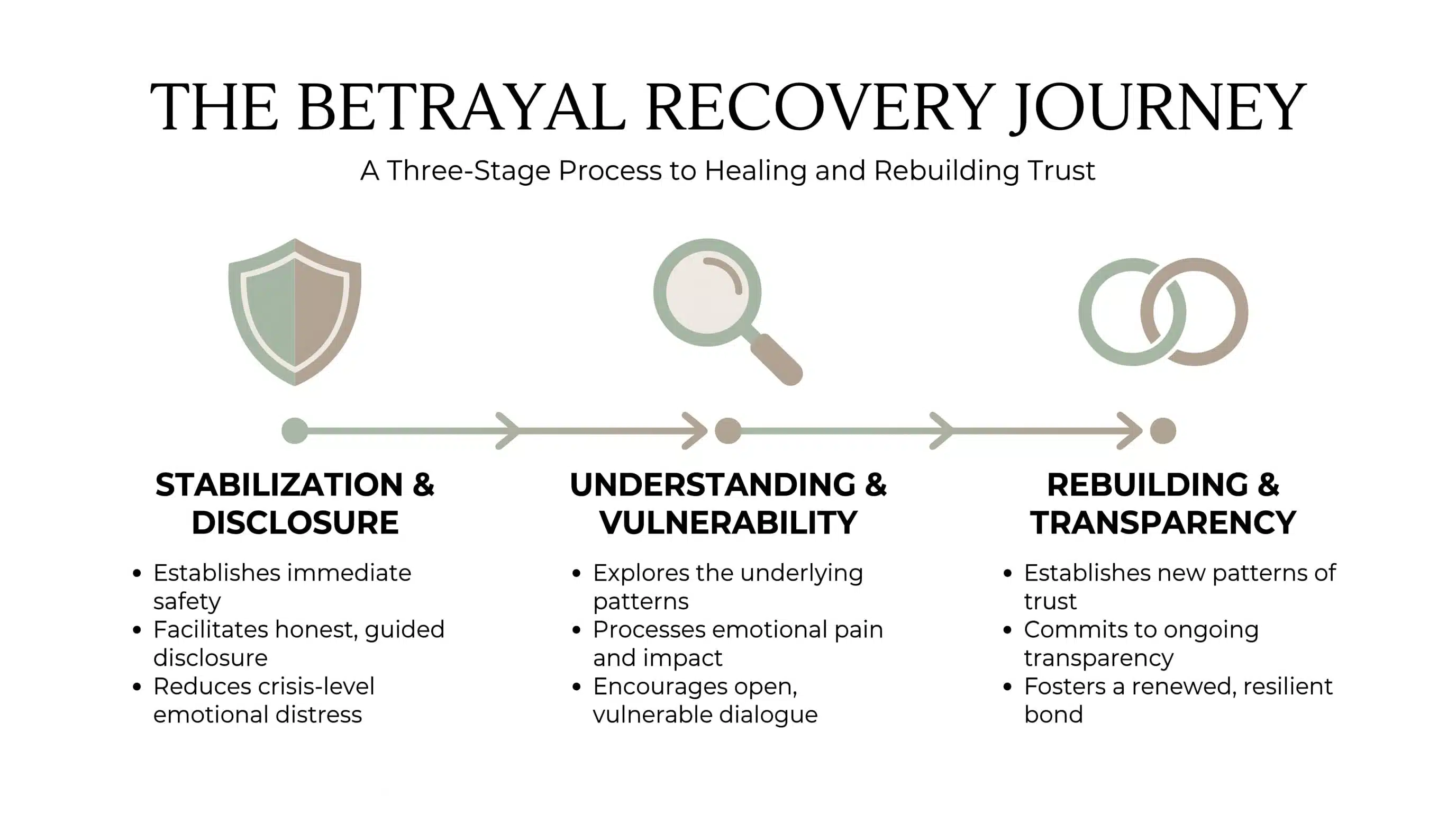
What Are the Three Phases of Affair Recovery?
- Stabilization and honest disclosure. The affair ends. We build a safe structure for talking about what happened, so questions get answered without fresh injuries.
- Understanding. We look at what made the relationship vulnerable. This is never about blaming the hurt partner; the choice to have an affair belongs to the person who made it.
- Rebuilding. Trust returns through steady transparency and repair of the emotional wound. Over time, you decide together what your marriage looks like now.
Most couples want to get past an affair quickly. Slowing down usually works better.
Trust comes back through small, reliable actions repeated over months, not through one big apology. That middle stretch is slow and unglamorous, and it’s where many couples quit. A steady therapist in the room makes it easier to keep going.
What If Only One of Us Wants to Try Counseling?
It happens more often than you might think. One partner is ready; the other is scared, ashamed, or simply unsure.
- Start with individual support. Individual therapy in Castle Rock can help you get steadier, and that alone often shifts the climate at home.
- Take the blame off the table. The reluctant partner is often the one most afraid of being blamed. Once they understand the first session isn’t a trial, many decide to come.
- Look after your own healing. If you’ve been betrayed and need support right now, read about rebuilding emotional safety after betrayal.
If an affair is sitting in the middle of your marriage right now, you don’t have to work out the next step by yourselves. Start rebuilding trust in a private, free consultation. Nothing is decided on that call.
If you’re ready to look for help, here’s what to look for close to home.
Local Therapy Support for Castle Rock Couples: How Do You Choose the Right Marriage Counselor?
Look for a counselor with specific couples training, real experience with infidelity, and a way of working that makes both of you feel safe from the first session. Practical fit matters too. Between I-25 commutes, kids’ schedules, and work, a therapist you can actually get to is one you’ll keep seeing, which is why we offer both in-person and telehealth sessions.
What Should You Look For in a Couples Therapist?
- Specific couples training. Ask about approaches like EFT or IBCT, not just general talk therapy.
- Experience with infidelity. This matters most if betrayal is part of your story.
- A no-blame stance. A good therapist never treats an affair as the hurt partner’s fault.
- Safety screening. Expect questions about safety early on.
- A felt sense of fit. You should both walk out feeling heard, not judged.
For more detail, see our fees, insurance and scheduling FAQ. We see couples from across Douglas County, including The Meadows, Founders Village, and Crystal Valley.
Rated 5 stars on Google · Serving Castle Rock couples since 2016
See if we’re the right fit, free and with no commitment.
Can Faith Be Part of Our Counseling?
Only if you want it to be. For couples who’d like their beliefs included, I offer Christian counseling in Castle Rock that brings faith in gently, with your consent, and at your pace.
Couples who prefer a secular approach are just as welcome. Not sure which fits? Get a personal recommendation in your free consultation.
Who Will You Be Working With in Castle Rock?
I’m Sheila Porter, MA, NCC, LPC, a Licensed Professional Counselor and National Certified Counselor. I founded Lifetouch Counseling in 2016, and these days I also mentor the therapists on our team in the same attuned, gentle approach.
Much of my training is in trauma therapy, including EMDR therapy in Castle Rock. When an old wound is fueling today’s arguments, we can work on it gently, so it stops running the marriage.
When couples counseling isn’t the right first step
- Safety comes first. If there is physical violence, threats, or coercive control in your relationship, joint sessions may not be safe.
- Start with individual support. The National Domestic Violence Hotline does not encourage couples counseling in abusive relationships.
- Get help now if you’re in danger. Call 911, or reach the Hotline at 1-800-799-7233 or by texting START to 88788.
Frequently Asked Questions About Marriage Counseling in Castle Rock
Before they start, most couples ask four things: how long it takes, what it costs, whether it works online, and whether it’s worth it if they’re unsure.
How long does marriage counseling take?
That depends on what you’re working through. Affair recovery usually takes longer than working on communication patterns alone.
Does insurance cover marriage counseling?
We’re out-of-network, but we provide superbills for possible reimbursement and accept HSA and FSA cards.
Can we do marriage counseling online?
Yes. We offer secure telehealth sessions for couples in Colorado, as well as in-person sessions in Castle Rock.
Is counseling worth it if we’re not sure we’ll stay together?
Often, yes. Counseling can help you reconnect, or help you reach a clear, respectful decision. Either way, you’ll be deciding with more understanding than you have now.
You Don’t Have to Carry This Alone
The Bottom Line
Having the same fight over and over, or reeling from an affair, doesn’t mean your marriage is finished. Evidence-based counseling helps about 70% of couples improve by interrupting the cycle, calming the nervous system, and rebuilding trust one step at a time. Here in Castle Rock, you can do that work in person or online.
I won’t pretend counseling is easy, or that every couple ends up where they hoped. It takes work, and some weeks feel harder before they feel better.
Still, since 2016 I’ve watched a lot of couples in our Castle Rock office find their way back to each other. Most of them started out just as unsure as you might feel right now.
If you’d like to take a first step, here’s how it works:
- Book a free 15-minute consultation through our contact page.
- Have a short, no-pressure call. Tell us what’s going on and ask about fit, cost, or scheduling.
- Decide what’s next. If it feels right, start in person at our Castle Rock office or online through telehealth.
Your partner doesn’t have to be ready yet. Plenty of couples begin with one person making the call.
Book your free 15-minute consultation and talk it through →
About the Author
Sheila Porter, MA, NCC, LPC is a Licensed Professional Counselor and National Certified Counselor who founded Lifetouch Counseling in Castle Rock, Colorado, in 2016. Trained at Denver Seminary, she has spent over a decade helping individuals and couples heal through trauma-informed approaches, including EMDR, Brainspotting, the Safe and Sound Protocol, and Emotionally Focused couples work. Her mission is to create a safe, compassionate space where every client feels “seen, heard, and felt,” and to mentor other therapists in that same attuned care. Read Sheila’s full bio →
Medical Disclaimer
The content on this page is for general informational and educational purposes only. It is not intended as, and should not be taken as, a substitute for professional medical or mental health advice, diagnosis, or treatment. Reading this article does not create a therapist-client relationship with Sheila Porter or Lifetouch Counseling, PLLC. Always seek the advice of a licensed mental health professional or other qualified health provider with any questions you have about your relationship, mental health, or a medical condition. Never disregard professional advice or delay seeking it because of something you have read on this website.
Recent Comments