

We expect to feel joyful, yet we find ourselves waking up at three in the morning with a racing heart. We assume we should feel accomplished, but instead, we feel exhausted and emotionally fragile.
Please know this: you are not failing, and your mind is not broken. You are simply navigating a transition, and transitions require a kind of internal map that we are rarely given.
Article Summary: Major life transitions dysregulate the nervous system, often triggering underlying trauma or relationship strain. While traditional talk therapy addresses cognitive processing, specialized interventions like EMDR, Brainspotting, and couples counseling provide somatic and relational stabilization. Professional mental health support helps individuals navigate these shifts by building long-term psychological resilience.
The Anatomy of Change: Why Even Positive Life Transitions Trigger Anxiety and Burnout
We tend to look at life through a linear lens, celebrating outward achievements while ignoring the complex internal shifts that must go with them. When we cross a major threshold, our environment changes overnight, but our internal world requires time to catch up.
In my practice at Lifetouch Counseling, I frequently sit across from high-achieving individuals who are deeply ashamed of their anxiety and would benefit from individual therapy in Castle Rock. They tell me, “I got the job I wanted, so why do I feel like I’m drowning?”
The answer doesn’t lie in your logic. It lies in your biology.
Beyond Logic: How Major Shifts Impact Your Nervous System
Your brain is fundamentally wired to keep you safe. To your survival brain, familiarity equals safety. Even when a past situation was stressful or unfulfilling, your nervous system knew exactly how to survive it.
When you enter a new phase of life, you introduce massive amounts of novelty. Your survival brain processes this novelty as unmapped territory filled with potential threats, not as exciting progress. Research published in PLOS ONE confirms that the amygdala, the brain’s threat-detection center, responds more strongly to novel stimuli than familiar ones, even when no real danger is present.
If your baseline capacity is already stretched thin, this influx of novelty can push your system past its threshold of resilience. This is when we begin to experience somatic dysregulation, meaning physical signs of a highly stressed nervous system.
- Hypervigilance: Feeling constantly on edge, irritable, or waiting for “the other shoe to drop.”
- Emotional Numbing: Feeling strangely disconnected or flat, even during moments that should bring joy.
- Executive Dysfunction: Finding it incredibly difficult to make simple decisions or focus on daily tasks.
- Physical Exhaustion: Waking up tired despite sleeping, or experiencing unexplained tension in your shoulders and jaw.
- Sleep Disruption: Having difficulty falling asleep, or waking up frequently between 2:00 AM and 4:00 AM.
If you recognize these symptoms in yourself, your body is simply trying to tell you that its baseline capacity has been exceeded.
To find our footing again, it helps to look at the landscape of change through a structured framework. Bridges reminds us that transition is not just a single event, but a three-part psychological process, one that begins internally, long before the outward change is complete.
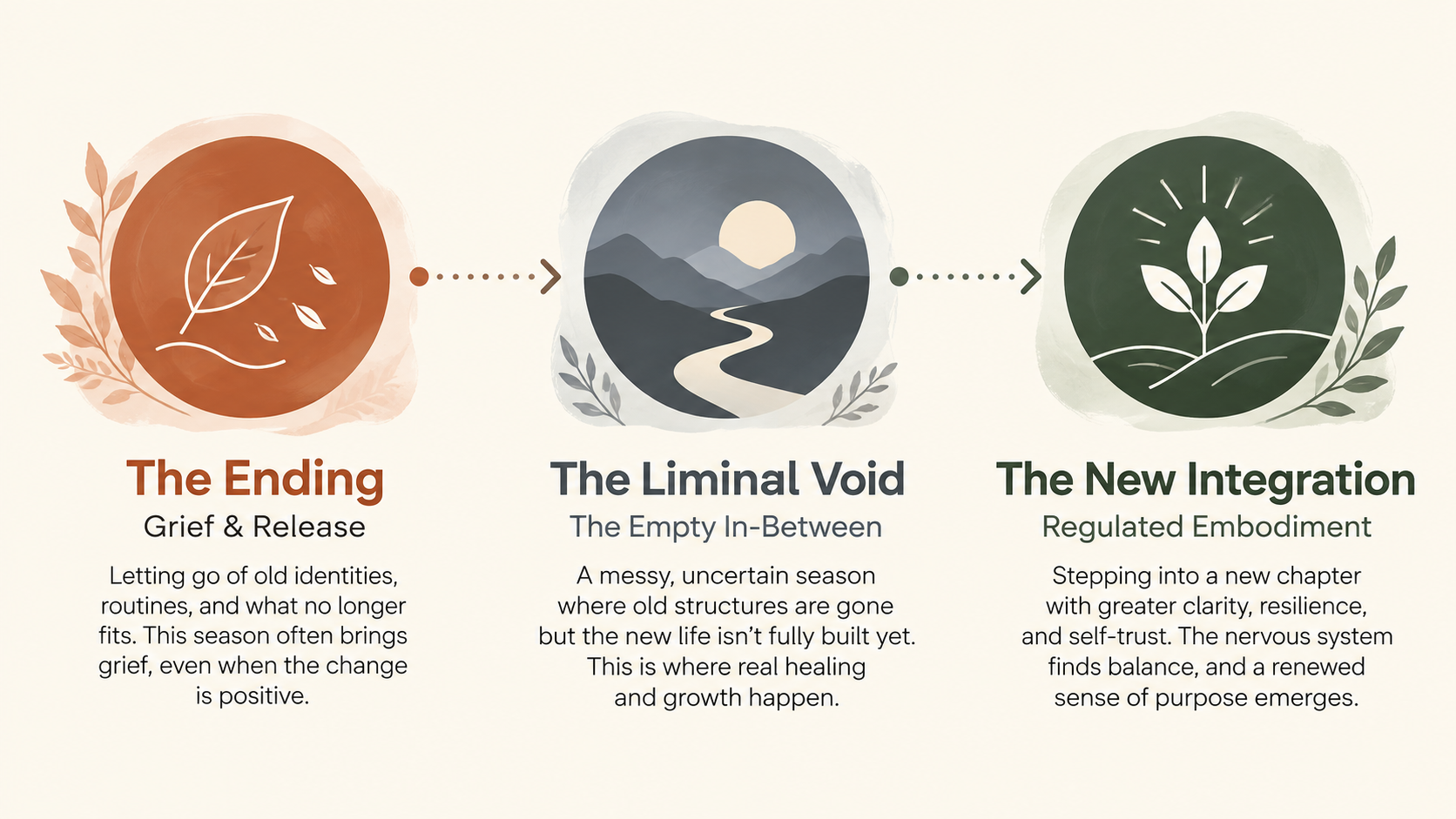
Phase 1: The Ending and Letting Go
Every new beginning requires an ending. Before we can fully inhabit our new role, we must acknowledge, grieve, and let go of what we are leaving behind. This is often the most painful part, as it requires us to release old identities, daily routines, or relationships that once defined us.
In the therapy room, this often looks like a client who has just retired but finds themselves weeping over the loss of their daily commute. It is not the traffic they miss; it is the structured boundary that told them who they were. We must honor these quiet endings before we can build anything new.
Phase 2: The Neutral Zone (The Sojourn)
This is the messy middle, the tender space between the old life we left and the new life we have not yet fully built. It can feel chaotic, confusing, and lonely. Yet, this “sojourn” is also where real growth takes place. It is a necessary period of quiet hibernation and realignment.
During this phase, clients often feel a strong urge to make impulsive decisions just to escape the discomfort of not knowing. We work together to slow things down, helping the nervous system tolerate the stillness of the in-between without rushing to fill the void.
Phase 3: The New Beginning
Only after we have walked through the neutral zone can we step into the third phase. The new beginning brings a renewed sense of energy, clarity, and purpose. We begin to understand our new identity and step forward with confidence.
This step does not happen because we forced it with positive thinking. It happens because we allowed our body the time it needed to integrate the change, showing our nervous system that we are safe in this new territory.
When the Ground Shifts Together: How Life Changes Strain Marriages and Relationships
It is a basic truth of human nature that we do not go through these transitions in isolation. When one partner in a relationship undergoes a major life shift, the entire relational ecosystem must adjust to accommodate the change.
If both partners are going through a transition simultaneously (like raising early childhood toddlers, relocating, or adjusting to retirement), the strain can feel overwhelming. Suddenly, the person you usually turn to for comfort is also struggling to find their own footing.
During major life transitions, our deepest attachment vulnerabilities are often brought to the surface. When our nervous systems are dysregulated, we naturally look to our partners to help us co-regulate a biological process in which one person’s nervous system helps stabilize another’s. A 2025 study published in Nature Scientific Reports found that partners’ autonomic nervous systems, cortisol levels, and emotional responses physically synchronize during shared stress, confirming that relationship strain during transitions is not just emotional it is physiological.
But if your partner is also feeling overwhelmed, they may shut down or become highly reactive.
In my own life, navigating the emotional aftermath of a major life change including the transitions of marriage and motherhood has not always come easily. I have had to grow deeply into these roles, learning firsthand that protecting a relationship during times of change requires us to stop blaming each other for our stress and start recognizing that the transition itself is the common challenge.
When communication breaks down, we can easily find ourselves trapped in cycles of resentment and distance.
A Supportive Next Step: If you feel the distance growing between you and your partner, please know that seeking support early is a profound act of care for your relationship. You can read our comprehensive marriage counseling guide for Castle Rock couples or explore how our dedicated couples therapy in Castle Rock can help you and your partner rebuild alignment and weather the storm together.
Rewiring Your Response: Moving Past Talk Therapy into Somatic Healing Modalities
When we are stuck in the survival loops of anxiety or depression, traditional talk therapy can sometimes feel like running in circles. We can talk about our stress logically, we can understand why we feel overwhelmed, but our body remains stuck in a state of high alert.
To create lasting change, we must address the somatic layer of our experience and show the nervous system that it is safe to settle.
At Lifetouch Counseling, we combine traditional, compassionate talk therapy with advanced, evidence-based neuro-somatic interventions that work directly with the brain and body.
EMDR and Brainspotting for Unresolved Transitional Blocks
Often, a current life transition feels overwhelming because it unknowingly triggers an unhealed wound from our past. If you experienced a past loss, betrayal, or period of instability, a current change can bring those old feelings of unsafety roaring back to life. Understanding how trauma responses show up during life transitions is often the first step toward lasting relief.
By using EMDR Therapy in Castle Rock and Brainspotting therapy, we can pinpoint where these trauma loops are stored in your subcortical brain. A systematic narrative review of randomized controlled trials published in Frontiers in Psychology found that EMDR therapy improved PTSD diagnosis, reduced trauma-related symptoms, and outperformed several other trauma treatments across diverse populations. These somatic tools allow us to process and release the emotional intensity of past experiences, freeing up your mental and physical capacity to handle the demands of your current life.
Brainspotting works through a related but distinct mechanism. Research published in the Medical Hypotheses journal proposed that focused eye positioning during Brainspotting engages the midbrain — particularly the superior colliculi — to access deeper subcortical spots where sensorimotor trauma memories are held, reaching material that logical conversation alone cannot touch.
Calming the Storm with the Safe and Sound Protocol (SSP)
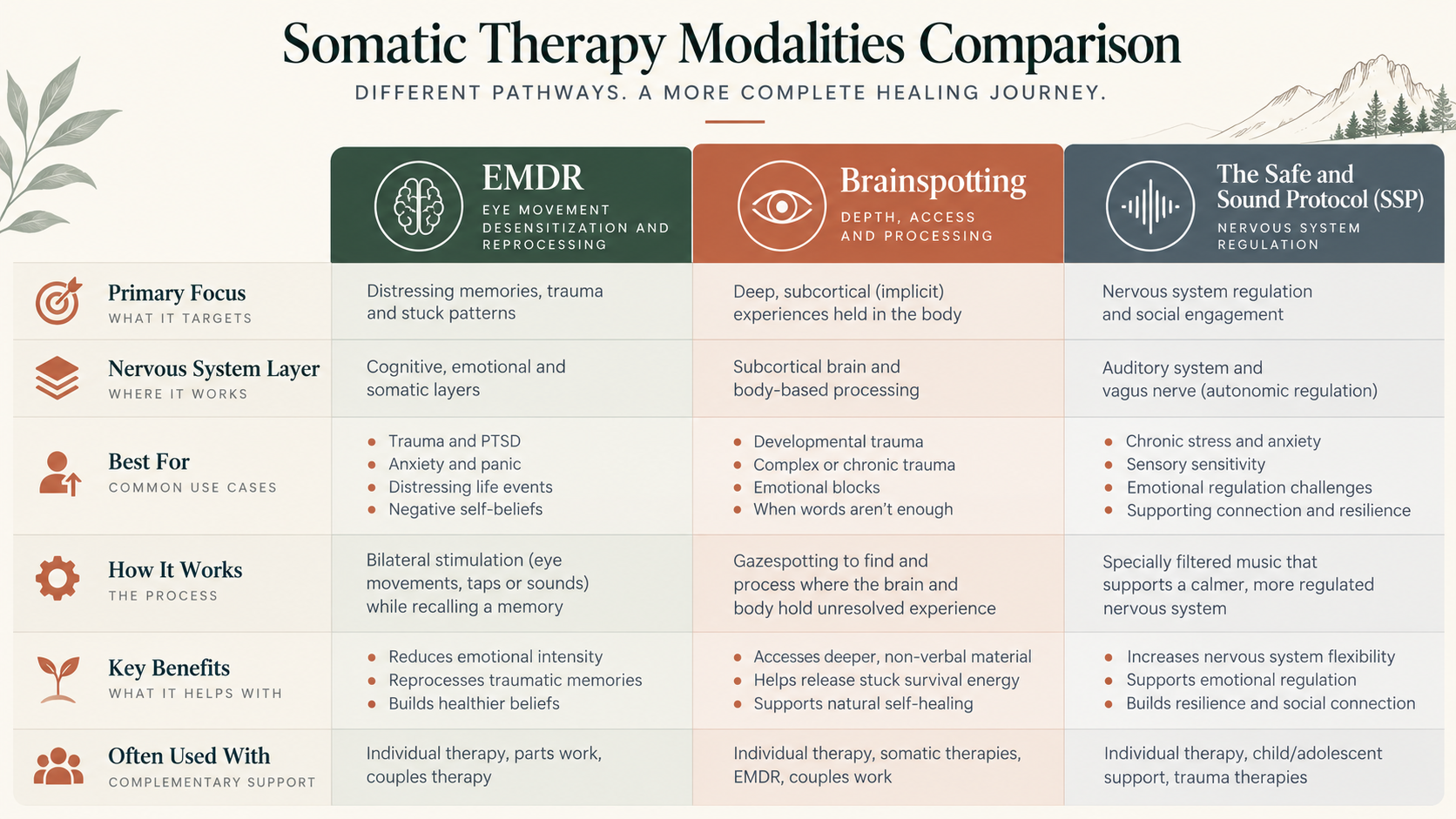
If you are experiencing emotional overload or early signs of burnout, your vagus nerve may need immediate, gentle support. The Safe and Sound Protocol therapy is a specialized, non-invasive auditory intervention designed to retune your nervous system back to a baseline of felt safety. Developed by Dr. Stephen Porges, the creator of Polyvagal Theory, the SSP uses specially filtered music to stimulate the neural pathways of the social engagement system — the same system responsible for helping humans recognize safety through vocal tone and facial expression.
By listening to specially filtered music, the SSP stimulates the neural pathways associated with social engagement and safety, helping you move out of defensive survival states and back into a state of grounded calm.
To help you understand how these somatic approaches differ from traditional methods, we have outlined their distinct pathways to healing below:
| Transition Challenge | Traditional Talk Therapy Approach | Advanced Somatic Approach (EMDR/Brainspotting/SSP) |
| Intellectualizing the Stress | Discussing the change logically to understand why it causes anxiety. | Processing the physical memory loop directly in the nervous system to stop the anxiety trigger at its source. |
| Feeling Emotionally Stuck | Tracking thoughts and behaviors using standard cognitive frameworks. | Bypassing cognitive defense shields to process raw emotional blockages held deep within the subcortical brain. |
| Nervous System Burnout | Relying on mental willpower, cognitive reframing, or forced relaxation techniques. | Utilizing targeted acoustic frequencies (SSP) to physically retune the vagus nerve to a baseline of felt safety. |
Step-by-Step: Fostering Resilience and Reclaiming Control Over Your Path
While working with an attuned professional provides the deepest path to healing, there are practical steps you can take today to support your nervous system as you navigate your current transition.
- Acknowledge and Validate Your State: Stop telling yourself you “should” be handling this better. Acknowledge that you are in a transition, and give yourself permission to feel overwhelmed.
- Identify the Historical Echoes: When a current stressor feels disproportionately intense, pause and ask yourself: “Does this feeling remind me of a time in my past when I felt unsafe, unseen, or out of control?”
- Engage in Daily Somatic Micro-Grounding: Throughout the day, take two minutes to anchor yourself. Place both feet flat on the floor, look around your room, and slowly name five things you can see, four things you can touch, and three things you can hear. This simple practice sends cues of safety to your nervous system.
- Protect Your Emotional Capacity: During a transition, your energy reserves are limited. Be intentional about saying “no” to non-essential obligations, and prioritize rest, nourishment, and gentle movement.
- Partner with a Specialized Professional: If your coping mechanisms feel exhausted, do not wait for complete burnout. Reach out to a professional who can help you process what logic alone cannot resolve.
Navigating transitions in a rapidly growing community like Castle Rock brings unique local and emotional dynamics.
How do I know if I need professional counseling for a life change?
It is completely normal to feel stressed during a transition. However, if your anxiety or sadness is lasting longer than a few weeks, interfering with your daily routines, disrupting your sleep, or causing strain in your relationships, it is a sign that your nervous system is overloaded and would benefit from professional guidance.
What makes somatic therapy better than regular talk therapy for handling stress?
Somatic therapies like EMDR, Brainspotting, and SSP do not replace talk therapy; they enhance it. While talk therapy helps you process your thoughts logically, somatic therapy works directly with the survival centers of your brain to release physical tension, regulate your nervous system, and clear the emotional blockages that willpower alone cannot reach.
Can a major transition cause issues in an otherwise healthy relationship?
Yes, absolutely. A major transition can shift the dynamics of a household and bring hidden attachment fears to the surface. When one or both partners are dysregulated, it is easy to fall into defensive communication patterns. Couples counseling can help you and your partner understand each other’s nervous system responses and restore your connection. For more answers on what to expect, you can explore our Therapy and Counseling FAQ for Castle Rock residents.
How do I choose between EMDR, Brainspotting, and the Safe and Sound Protocol?
You do not have to make this choice alone. During our initial sessions, we look closely at how your nervous system is reacting to the transition. If you are experiencing looping, distressing memories, EMDR Therapy in Castle Rock can help clear those pathways. If you feel a deep, wordless physical block, Brainspotting therapy helps access those deeper subcortical spots. If you are simply in a state of high-alert burnout, we often start with the Safe and Sound Protocol therapy to gently calm your vagus nerve first.
How long does it typically take to find my footing again during a transition?
There is no fixed calendar for healing, as every nervous system processes stress at its own natural pace. A gentle situational shift may begin to feel lighter after just a few sessions of somatic grounding. However, if this transition has touched a deeper, older wound, the journey will require a longer, more patient sojourn. Our goal is never to rush you, but to help you build the sustainable internal capacity needed to carry you safely into your next chapter.
Your Transition Deserves a Safe Place to Land
You do not have to carry the emotional weight of this new chapter by yourself. If you are feeling overwhelmed, stuck, or disconnected from the people you love, I invite you to reach out. At Lifetouch Counseling, we are dedicated to helping you feel seen, heard, and deeply supported as you navigate your path toward healing and restoration.
Contact Sheila Porter and the team at Lifetouch Counseling today to schedule your free 15-minute consultation. Let us walk with you as you step confidently into your future.
Recent Comments