

What Emotional Overload Looks Like in Women
Emotional overload in women often shows up as irritability, persistent fatigue, mental fog, and the feeling of carrying too many responsibilities at once. It’s the mind and body’s way of signaling that your load has become too heavy to manage alone.
According to the American Psychological Association, chronic stress disproportionately affects women, with nearly 50% reporting physical and emotional symptoms of overwhelm (APA, 2023). Here are common signs of emotional overload:
- Feeling responsible for everything and everyone
- Difficulty focusing or thinking clearly
- Emotional sensitivity or irritability
- Feeling on edge or close to tears
- Persistent exhaustion, even after rest
In my work with women, I often see emotional overload long before burnout ever shows up — it’s the body whispering for help before it’s forced to shout.
Mini FAQ
- What does emotional overload feel like? It often feels like being emotionally maxed out and unable to recover your sense of calm.
- Is emotional overload the same as stress? Stress is a response to a challenge; emotional overload happens when those challenges stack up without relief.
Key Takeaways
- Emotional overload is an early warning sign the nervous system is strained.
- Many women dismiss overload as “normal busyness,” making it easy to miss.
- Emotional overload often precedes burnout if support isn’t available.
Early Signs of Burnout Women Commonly Miss
Early burnout symptoms in women include emotional numbness, sleep disruptions, reduced motivation, and an ongoing sense of pushing through the day. These subtle signs are often mistaken for simple tiredness.
Research from the World Health Organization notes that burnout is now recognized as an occupational phenomenon resulting from chronic workplace stress (WHO, 2019). These early burnout markers often include:
- Feeling emotionally blank or disconnected
- Rest that doesn’t actually recharge you
- Losing patience more quickly
- Avoiding responsibilities or social interactions
- Feeling like joy is harder to access
A woman once shared with me that she “felt like a dimmed version of herself,” quietly burning out even while appearing strong to others.
Mini FAQ
- How do I know if it’s burnout or tiredness? Tiredness improves with rest; burnout lingers, even after you try to recharge.
- What are subtle burnout signs women overlook? Emotional numbness, irritability, and a growing dread about daily tasks often go unnoticed.
Key Takeaways
- Burnout builds slowly and quietly.
- Women often normalize exhaustion until it becomes unmanageable.
- Persistent numbness or irritability may signal deeper emotional strain.
Burnout vs. Emotional Overload — How They Differ
Emotional overload is a short-term reaction to too many demands at once, while burnout is a long-term state of emotional, mental, and physical exhaustion that develops gradually.
While emotional overload feels like a sudden surge of overwhelm, burnout is a slow, steady drain — one that leaves you running on empty.
| Emotional Overload | Burnout |
| Short-term overwhelm | Long-term depletion |
| Triggered by immediate demands | Built over weeks or months |
| Emotional flooding | Emotional numbness |
| May resolve with rest | Requires deeper healing |
Mini FAQ
- Can emotional overload turn into burnout? Yes — repeated overload without relief can deepen into burnout.
- How long does burnout take to develop? It typically develops over weeks or months of sustained stress.
Why Women Experience Burnout Differently
Women often experience burnout differently because of the mental load, emotional labor, caregiving roles, and expectations to remain composed even when overwhelmed. These layers of responsibility can make burnout feel like a personal failure rather than a human response.
Women often carry invisible work and research supports this. A 2023 McKinsey report found that women perform 60% more household and emotional labor than men, contributing to higher burnout rates. Women often carry invisible work, coordinating schedules, supporting others emotionally, remembering details no one else tracks, and anticipating needs before they’re spoken. Over time, this takes an emotional toll.
Contributing factors include:
- Caregiving expectations at home and work
- Pressure to be emotionally available
- Perfectionism or self-blame
- Cultural or faith expectations to “hold it all together”
One woman described it as “carrying the world in her mind,” even when no one could see the weight.
Mini FAQ
- What is the mental load in women? It’s the ongoing emotional, logistical, and anticipatory responsibilities many women carry daily.
- Why do women blame themselves for burnout? Because they’re often conditioned to prioritize others and view exhaustion as a personal inadequacy.
How Therapy Helps Women Recover From Burnout
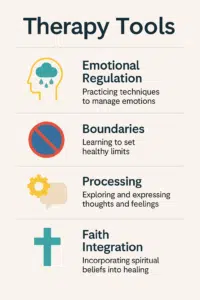
Therapy supports burnout recovery by identifying stress patterns, helping women rebuild boundaries, and offering tools for emotional regulation. It provides a safe, compassionate space to slow down and feel supported rather than depleted.
Therapy can help women:
- Understand their stress responses
- Process emotional overload safely
- Rebuild inner steadiness and confidence
- Create healthier boundaries
- Explore trauma patterns such as fawning or shutdown
If faith is meaningful to you, therapy can weave in Scripture, prayer, or grounding spiritual practices, supporting both emotional and spiritual healing.
Mini FAQ
- What type of therapy helps with burnout? Trauma-informed therapy, EMDR, CBT, and faith-based counseling are all effective.
- Can faith be part of burnout recovery? Yes, blending faith with therapy often brings grounding and renewed hope.
When to Seek Counseling for Emotional Overload
It may be time to seek therapy when overwhelm starts affecting your sleep, relationships, motivation, or emotional stability or when you simply feel tired of carrying so much alone.
Signs counseling may help include:
- Exhaustion that doesn’t improve with rest
- Increased irritability or emotional sensitivity
- Feeling overwhelmed by small tasks
- Disconnection from yourself or others
- Feeling like you’re coping alone without relief
Therapy isn’t a last resort, it’s a supportive place to slow down, breathe, and feel genuinely cared for.
Mini FAQ
- How do I know it’s time to get help? If overwhelm has become your baseline or coping isn’t helping, therapy can make a meaningful difference.
- Should I seek therapy even if I’m functioning? Yes, functioning doesn’t mean you’re thriving.
What to Do When Emotional Overload Hits
When emotional overload hits, grounding practices and supportive pauses can help shift you from survival mode into steadiness.
Try these simple, grounding steps:
- Pause and Breathe: Slow, deep breaths help regulate your nervous system.
- Name What You’re Carrying: Putting feelings into words reduces intensity.
- Take a Micro-Break: Step outside, drink water, or sit in quiet stillness.
- Invite God Into the Moment: A short prayer or verse may bring comfort.
Mini FAQ
- What helps in the moment of overwhelm? Grounding, breathwork, and gentle self-compassion help calm the nervous system.
A Gentle Invitation to Support
If you’re ready to feel more supported and regain emotional clarity, LifeTouch Counseling offers a warm, compassionate space for women in the Castle Rock area.
You don’t have to carry this alone. Whether you’re navigating burnout, emotional overload, or the weight of the mental load, support is here for you and faith can be woven in whenever it feels meaningful.
Author
As a therapist at LifeTouch Counseling, I specialize in supporting women who feel overwhelmed, burned out, or disconnected from themselves. My work integrates trauma-informed care, emotional regulation, and optional faith-based approaches so you can experience healing in a way that feels authentic, safe, and deeply compassionate.
Recent Comments